 Dubai
Dubai
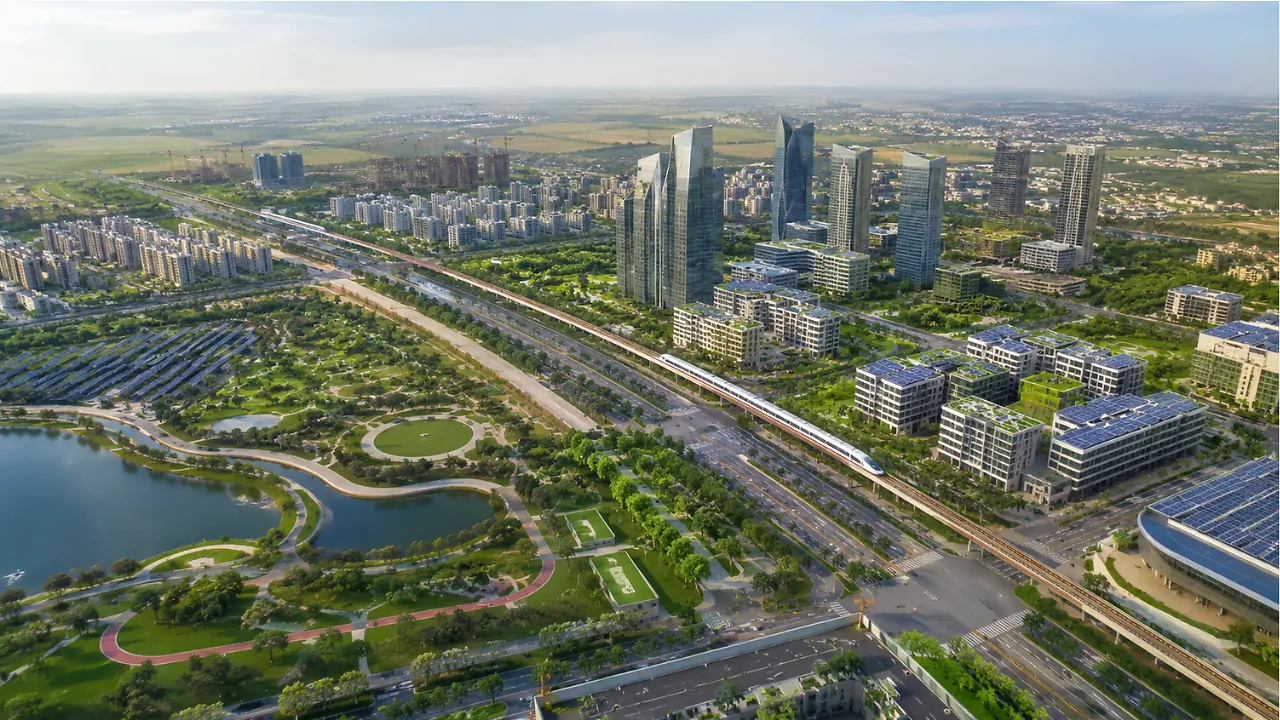
Four 'Namo Cities' Could Create a New Real Estate Map for Delhi-NCR
Delhi-NCR could be heading toward one of its biggest urban transformations in decades.
Under the proposed Regional Plan 2041, the National Capital Region Planning Board (NCRPB) has proposed four new "Namo Cities" — semi-greenfield, mixed-use urban centres planned around existing or proposed Namo Bharat Regional Rapid Transit System (RRTS) stations.
The proposal covers Delhi, Haryana, Uttar Pradesh and Rajasthan, with one city planned in each participating NCR state. The objective is to create more balanced, sustainable and connected urban growth while reducing pressure on established centres such as Delhi, Gurugram, Noida and Ghaziabad.
For the real estate sector, the concept could be significant.
If implemented effectively, these cities could shift the NCR property market from a handful of dominant urban centres toward a more polycentric real estate ecosystem, where housing, employment, retail and commercial activity develop around high-capacity regional transport.

What Are Namo Cities?
Namo Cities are proposed as mixed-use, transit-oriented urban centres built around the Namo Bharat RRTS network.
Instead of developing housing first and adding transport infrastructure later, the concept is based on Transit-Oriented Development (TOD) — concentrating residential, commercial, retail and social infrastructure around high-capacity public transport.
The NCRPB's June 2026 meeting proposed four semi-greenfield cities at selected existing and proposed stations on Namo Bharat RRTS lines. The locations are to be identified through a competitive process involving the participating NCR states.
This is important because the real estate impact of a transit-oriented city can extend well beyond the immediate station area.
A successful Namo City could create an entire ecosystem of:
Residential neighbourhoods
Commercial districts
Retail centres
Offices
Schools
Healthcare facilities
Recreational spaces
Public infrastructure
Logistics and employment hubs
That could create new property markets instead of simply expanding existing cities outward.
Four Namo Cities: Where Will They Come Up?
One of the most important facts to understand is that the four final locations were not originally announced as four confirmed city sites.
The NCRPB proposal provides for:
Region | Proposed Namo City | Current Position |
|---|---|---|
Delhi | 1 city/sub-city | Proposal/selection process |
Haryana | 1 city | Development process has advanced |
Uttar Pradesh | 1 city | Proposal/selection process |
Rajasthan | 1 city | Proposal/selection process |
The NCRPB decided that each participating state would submit proposals, with the cities planned around RRTS transport nodes.
Therefore, property buyers should be careful with claims that a particular village, sector or project is already "inside Namo City."
The planning process is evolving, and official notifications should be checked before treating a location as confirmed.
Haryana's Namo City Moves Further Ahead
Among the four proposed cities, Haryana's plan has attracted particular attention because the state has moved into a more concrete land-development process.
According to ThePrint, Haryana has identified an approximately 9,000-acre area across parts of Jhajjar, Sonipat and Rohtak districts for a proposed Namo City around the Kundli-Manesar-Palwal (KMP) Expressway and upcoming Delhi-Katra Expressway.
Farmers in identified villages have been asked to provide consent through the e-Bhoomi portal.
This represents a much more tangible development signal than the initial June announcement.
However, it is still important to distinguish between land procurement/planning activity and completed urban development. Construction and full-scale real estate development will require multiple subsequent planning, approval and infrastructure stages.
₹5,000 Crore Support Package Could Accelerate Development
The NCRPB has proposed a ₹5,000 crore performance-linked support package for the Namo Cities initiative.
According to the government's June announcement, the support is structured as a combination of:
Grants
Loans
Guarantees
The package includes a ₹1,000 crore grant component. The objective is to catalyse development at selected growth nodes.
Namo Cities Funding Framework
Component | Amount |
|---|---|
Total proposed support | ₹5,000 crore |
Grant component | ₹1,000 crore |
Other support | Loans + guarantees |
Intended period | Five years |
Purpose | Catalyse urban growth nodes |
The ₹5,000 crore should therefore not be interpreted as the total construction cost of four cities.
It is a performance-linked central support mechanism intended to help states develop the proposed urban nodes.
Why Namo Cities Matter for Real Estate
The biggest potential impact could come from changing where future housing demand is located.
Delhi-NCR has traditionally been dominated by established centres such as:
Delhi → Gurugram → Noida → Ghaziabad → Faridabad
But population growth, land costs, congestion and infrastructure pressure are increasingly pushing development toward peripheral corridors.
Namo Cities could accelerate this transition by creating planned urban centres around regional transport rather than allowing disconnected suburban expansion.
Business Standard noted that the initiative is intended to create new transit-oriented urban centres and potentially develop future growth corridors similar to the evolution of Gurugram and Noida.
Transit Could Become the New Real Estate Driver
The most important concept behind Namo Cities is connectivity.
Real estate markets often respond strongly to improvements in travel time and accessibility.
NCR's existing Namo Bharat network demonstrates the potential of regional rail to connect previously separated urban markets.
The National Capital Region Transport Corporation (NCRTC) itself describes Namo Bharat's potential impact in terms of polycentric growth, improved access to jobs and facilities, reduced congestion and greater economic activity across the region.
This could have a direct effect on property markets.
If residents can live farther from Delhi or existing employment centres without accepting significantly longer commutes, developers have more land on which to build large residential communities.
That could eventually create new price bands and investment markets.
From City-Centric to Corridor-Centric Real Estate
The NCR real estate market has already demonstrated the importance of infrastructure corridors.
Examples include:
Dwarka Expressway
Golf Course Extension Road
Noida-Greater Noida Expressway
Yamuna Expressway
Delhi-Meerut RRTS corridor
KMP Expressway
Namo Cities could take this model one step further.
Instead of simply developing projects along a road or transport corridor, the objective is to create an entire urban ecosystem around transport nodes.
This could mean:
Transport → Employment → Housing → Retail → Social Infrastructure → Economic Activity
That creates a much stronger foundation for long-term real estate demand than residential development alone.
Potential Impact on Residential Real Estate
Residential property could be one of the biggest beneficiaries if Namo Cities are implemented successfully.
A planned city can create different housing segments, including:
Affordable Housing
Lower land and development costs could allow developers to create relatively more affordable housing compared with established NCR centres.
Mid-Segment Housing
This could become particularly important for professionals who work in NCR but want larger homes at lower entry prices.
Premium Housing
As employment centres and infrastructure develop, premium residential communities could emerge around major transit nodes.
Rental Housing
A growing workforce would create demand for rental apartments, co-living and serviced accommodation.
Commercial Real Estate Could Be an Even Bigger Beneficiary
Namo Cities are not planned as residential colonies.
The objective is to create self-reliant urban centres, which means employment and commercial infrastructure will be critical.
This could create demand for:
Office space
Retail
High-street developments
Warehousing
Hospitality
Healthcare
Education
Entertainment
Co-working spaces
This is important because sustainable real estate growth generally requires more than residential buyers.
Jobs create residents. Residents create consumption. Consumption creates commercial demand.
That cycle can potentially turn a new urban node into a self-sustaining market.
Could Namo Cities Become the Next Gurugram or Noida?
This is perhaps the biggest question for real estate investors.
The answer is: potentially, but not immediately.
Gurugram and Noida did not become major urban centres simply because land was available.
Their growth was supported by a combination of:
Infrastructure
Employment
Corporate investment
Government planning
Connectivity
Residential development
Commercial real estate
Population migration
Namo Cities will need the same ecosystem to develop successfully.
Transport infrastructure can act as a catalyst, but jobs and economic activity ultimately determine whether a city becomes self-sustaining.
Potential Impact on Existing NCR Markets
The Namo Cities initiative could affect established real estate markets in several ways.
Existing Market | Potential Impact |
|---|---|
Delhi | Reduced pressure from population growth |
Gurugram | Greater competition from emerging employment centres |
Noida | Potential shift toward newer peripheral hubs |
Ghaziabad | Improved regional connectivity could strengthen surrounding markets |
Faridabad | Potential benefit from wider NCR infrastructure integration |
Greater Noida | Competition and collaboration with new growth nodes |
Peripheral NCR | Potential acceleration of land development |
This does not necessarily mean established markets will lose demand.
Instead, the NCR could become more polycentric, with several strong urban centres connected through regional transportation.
Land Values Could React Before Cities Are Built
One of the biggest real estate effects of large infrastructure announcements is that land markets often react before physical development arrives.
Once a future transport corridor or city is announced, landowners and developers may begin positioning themselves around expected growth.
This can create:
Increased land enquiries
Development activity
Speculative investment
Higher land prices
New plotted developments
Increased developer acquisitions
However, this is also where buyers need to be most cautious.
A government announcement does not automatically make every nearby parcel an investment opportunity.
Until the exact planning boundaries, land-use permissions, infrastructure timelines and approvals are confirmed, future appreciation remains speculative.
Why Investors Should Not Rush Into "Namo City" Properties
This is an important fact-check point.
The Namo Cities proposal has already generated significant interest among property investors and developers.
But buyers should distinguish between:
Confirmed government planning
and
Marketing claims by private sellers.
A property being described as:
"Near Namo City"
"Inside future Namo City"
"Namo City approved"
"Namo City investment zone"
does not by itself establish that the property is officially part of the project.
Buyers should verify:
Official government notification
Exact project boundary
Land-use classification
RERA registration
Development approvals
Master-plan zoning
Infrastructure timeline
Ownership/title documents
This is particularly important because the four-city concept is still progressing through planning and implementation stages.
Namo Cities and the NCR Regional Plan 2041
The Namo Cities initiative is part of a much broader vision under NCR Regional Plan 2041.
The plan focuses on several interconnected themes:
Regional mobility
Sustainable urban development
Economic corridors
Housing
Environmental protection
Transit-oriented development
Balanced growth
The NCRPB has also decided to retain the existing geographical boundaries of the NCR rather than reduce its current extent.
This matters because Namo Cities are not being proposed as isolated townships.
They are intended to become part of a larger regional development strategy.
The 30-Minute NCR Vision
Another important element of the broader Regional Plan 2041 discussion is the idea of improving regional mobility so that people can access employment and services within substantially shorter travel times.
A stronger regional transport network could reduce the importance of living immediately next to one's workplace.
That could fundamentally change residential decision-making.
Instead of asking:
"How close is this home to my office?"
future buyers may increasingly ask:
"How quickly can I reach my office through the regional transit network?"
That shift could significantly expand the potential residential catchment of NCR's emerging markets.
Namo Cities Could Create New Real Estate Micro-Markets
If the planned cities progress successfully, the biggest beneficiaries may not necessarily be today's most expensive locations.
Instead, new micro-markets could emerge around:
RRTS stations
Employment centres
Commercial districts
Industrial hubs
Logistics corridors
Expressway intersections
The first phase may attract land investors and developers.
The next phase could attract homebuyers.
The final phase could see established commercial, retail and rental markets.
This is how a transport-led development corridor can gradually become a mature urban market.
Key Risks and Challenges
The Namo Cities concept has significant potential, but execution will determine its real estate impact.
Land Acquisition
Large-scale urban development requires substantial land assembly and stakeholder participation.
Haryana's current land-consent process demonstrates that land availability and farmer participation can be important implementation issues.
Infrastructure Execution
Roads, water, sewerage, electricity, public transport and social infrastructure must develop alongside housing.
Employment Generation
A city cannot become self-sustaining purely through residential construction.
Regulatory Coordination
NCR involves the Centre, Delhi, Haryana, Uttar Pradesh and Rajasthan. Coordination across multiple authorities will be essential.
Timeline
Large greenfield or semi-greenfield cities take years to develop.
Investors expecting rapid price appreciation purely because of the announcement may underestimate the development timeline.
The official NCRPB/PIB announcement confirms the four-city concept, TOD model and ₹5,000 crore performance-linked support framework.
What This Could Mean for NCR Property Investors
For investors, Namo Cities should be viewed as a long-term urbanisation theme, rather than a short-term property tip.
The most important indicators to track will be:
1. Final city locations
Which proposals are officially selected?
2. RRTS connectivity
How close will the final urban centres be to operational or approved regional transit?
3. Land-use plans
Will the selected areas have adequate residential, commercial and institutional development capacity?
4. Employment
Which industries and businesses will create jobs?
5. Infrastructure spending
How quickly will roads, utilities and social infrastructure arrive?
6. Developer participation
Which major developers begin acquiring land or launching projects?
These indicators will provide a much stronger basis for investment decisions than the Namo City announcement alone.
Namo Cities: Potential Real Estate Impact at a Glance
Real Estate Segment | Potential Impact |
|---|---|
Residential | New housing markets and larger supply |
Affordable Housing | Potential improvement in land economics |
Premium Housing | New lifestyle communities around planned hubs |
Commercial | Offices, retail and high streets |
Warehousing | Growth around transport and industrial corridors |
Hospitality | Increased demand as economic activity develops |
Rental Housing | Potential growth with employment |
Land | Increased developer and investor interest |
Infrastructure | Major catalyst for surrounding markets |
Existing NCR hubs | Greater regional competition and integration |
Frequently Asked Questions
What are Namo Cities?
Namo Cities are four proposed semi-greenfield, mixed-use, transit-oriented urban centres planned under the NCR Regional Plan 2041 around selected Namo Bharat RRTS stations.
How many Namo Cities are planned?
Four Namo Cities are proposed — one each in Delhi, Haryana, Uttar Pradesh and Rajasthan.
How much funding is proposed for Namo Cities?
The NCRPB has proposed a ₹5,000 crore performance-linked support package, comprising grants, loans and guarantees. The grant component is ₹1,000 crore.
Where will the Namo Cities be located?
The final locations are being determined through a competitive process among the NCR participating states. Haryana has, however, progressed with a roughly 9,000-acre land-development process spanning parts of Jhajjar, Sonipat and Rohtak.
Will Namo Cities affect Gurugram and Noida property prices?
Potentially, over the long term. New planned urban centres could create additional housing and employment markets, increasing competition while also strengthening overall NCR connectivity.
Are Namo Cities already developed?
No. The initiative is at different stages of planning and implementation. Haryana has moved further into land-development activity, but the broader four-city programme remains a long-term development initiative.
Is buying land near a proposed Namo City a good investment?
Not necessarily. Investors should first verify the official boundary, land-use status, approvals, RERA registration where applicable and infrastructure timeline. Proximity to a proposed city does not guarantee appreciation.
How could Namo Cities change NCR real estate?
If successfully implemented, they could create new residential, commercial and employment centres around regional transit, making NCR more polycentric and reducing dependence on established centres such as Delhi, Gurugram and Noida.
Conclusion
The proposed four Namo Cities could become one of the most important long-term urban-development initiatives for Delhi-NCR.
The concept goes beyond building new residential sectors. By combining Transit-Oriented Development, Namo Bharat connectivity, housing, employment, commercial infrastructure and social amenities, the initiative aims to create new self-sustaining urban centres.
For real estate, that could mean a fundamental change in how NCR grows.
Instead of development remaining concentrated around established markets such as Delhi, Gurugram, Noida and Ghaziabad, future growth could increasingly spread across multiple connected urban nodes.
The opportunity is significant, but so is the timeline.
The key takeaway for property buyers and investors is simple:
Don't invest in a "Namo City story" — invest only after verifying the actual city location, planning boundary, land use, infrastructure and approvals.
If the planning vision is successfully executed, however, these four cities could play an important role in creating NCR's next generation of real estate growth corridors.
Looking for Property Opportunities Across Delhi-NCR?
Interested in Gurugram, Noida, Greater Noida, Yamuna Expressway, Sonipat or emerging NCR growth corridors?
Our real estate advisory team can help you compare upcoming projects, locations, infrastructure connectivity and investment potential.
Call / WhatsApp: +91 8059912000