 Dubai
Dubai
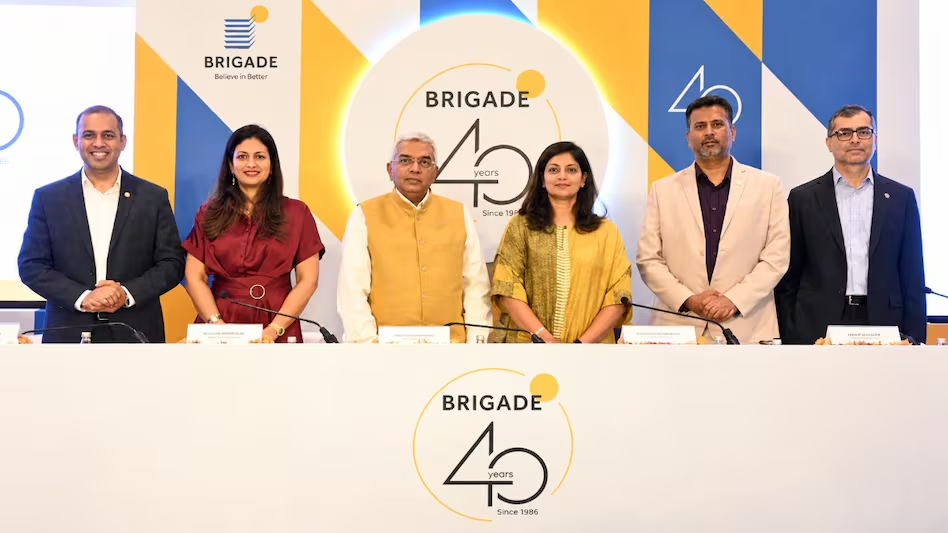
India’s real estate sector is preparing for another major expansion phase as Brigade Group has announced plans to invest approximately ₹40,000 crore over the next three years to expand its residential, commercial, retail, hospitality and warehousing businesses across South India.
The Bengaluru-based developer announced the investment roadmap on October 8, 2026, as it marked 40 years in the real estate industry. The company aims to build a development pipeline of approximately 40 million sq ft, with a focus on strengthening its existing markets and expanding into new opportunities.

Brigade Group’s ₹40,000 Crore Investment Plan: Key Highlights
Particulars | Details |
|---|---|
Developer | Brigade Group |
Planned Investment | ₹40,000 crore |
Investment Period | Next 3 years |
Target Development Pipeline | 40 million sq ft |
Primary Focus | South India |
Residential Allocation | Approximately 70% |
Commercial Allocation | Approximately 20% |
Hospitality Allocation | Approximately 10% |
Estimated Gross Development Value | Reported at ₹65,000–70,000 crore by Hindustan Times |
The planned investment will be directed towards multiple real estate segments, with residential development receiving the largest share.
How Will Brigade Group Allocate Its Investment?
Brigade Group plans to distribute its investment across three primary segments, reflecting its diversified real estate portfolio.
1. Residential Real Estate: 70% Allocation
Approximately 70% of the planned investment will be allocated to residential projects.
This makes housing the central pillar of Brigade Group’s next growth phase. The allocation could support the development of new residential communities, premium housing projects and other residential opportunities across its target markets.
For the residential property market, a larger development pipeline could increase the supply of homes across different locations and buyer segments. Actual market impact will depend on project launches, pricing, construction progress and buyer demand.
2. Commercial and Retail Real Estate: 20% Allocation
Around 20% of the investment is earmarked for commercial developments, including office and retail assets.
Brigade Group has an established presence in commercial real estate through its office developments and World Trade Centre platform.
The company has also secured licences for three additional World Trade Centre developments in Devanahalli and Whitefield in Bengaluru, and Coimbatore. These projects form part of its broader commercial growth strategy.
Commercial expansion could support the development of business districts, office spaces and retail destinations in markets with growing employment and consumption demand.
3. Hospitality: 10% Allocation
The remaining 10% of the planned investment will be directed towards hospitality.
Brigade Group's diversified portfolio already includes hotels and hospitality assets. Further investment in this segment could strengthen its presence in destinations where business travel, tourism and commercial activity support demand for accommodation.
The company is also pursuing growth across emerging business areas, including warehousing. The precise allocation for warehousing has not been separately disclosed in the reported investment breakdown.
Chennai and Hyderabad Emerge as Expansion Markets
An important part of Brigade Group’s strategy is expanding its presence in major South Indian cities.
The company has identified Chennai and Hyderabad as important markets for its next phase of growth, including developments under its flagship Orion brand.
These cities offer established residential markets, commercial activity and opportunities for mixed-use and retail development. However, the success of individual projects will depend on local demand, location, pricing and execution.
Bengaluru will continue to be central to Brigade Group’s strategy, while its plans across Coimbatore and other South Indian markets could broaden its development footprint.
What Does the ₹40,000 Crore Plan Mean for South India's Real Estate Market?
Brigade Group’s announcement reflects the scale at which established developers are preparing for the next phase of real estate development.
The potential impact extends across several segments.
Real Estate Segment | Potential Impact |
|---|---|
Residential | Additional housing supply and new project launches |
Commercial | Expansion of office developments and business districts |
Retail | New retail destinations and consumption-led developments |
Hospitality | Additional hotel and hospitality investment |
Warehousing | Opportunities in logistics and industrial real estate |
The actual impact will depend on the timing of investments, availability of land, funding, project approvals and market absorption.
For homebuyers, additional launches could create more choices in selected markets. For commercial occupiers, new office developments could provide further options for expansion. Investors, meanwhile, will need to evaluate each project individually rather than assuming that a larger development pipeline guarantees higher returns.
Brigade Group's 40-Year Real Estate Journey
Brigade Group has developed a diversified portfolio across residential communities, office developments, retail destinations and hotels.
According to reports published around its 40th anniversary, the company has developed more than 110 million sq ft across over 300 projects in 10 cities.
Its next phase of growth is aimed at building on this existing platform through new developments, partnerships and expansion into additional markets.
The company has indicated that the planned investments will be funded through a combination of internal accruals, project-level financing, strategic partnerships and other suitable funding avenues.
This approach allows the developer to pursue a larger project pipeline while maintaining a focus on capital allocation and project execution.
What Is Gross Development Value (GDV)?
The investment announcement also highlights the importance of distinguishing between investment and Gross Development Value.
Investment refers to the capital planned for development, while Gross Development Value (GDV) represents the estimated total sales value of a development once completed and sold, subject to the assumptions used.
Brigade Group's planned investment is approximately ₹40,000 crore. Hindustan Times reported an estimated GDV of ₹65,000–70,000 crore for the planned pipeline. These are different financial measures and should not be interpreted as equivalent figures or guaranteed profit.
Actual revenue, margins and returns will depend on project costs, sales, execution and market conditions.
What Should Homebuyers and Investors Watch?
Brigade Group’s expansion plan creates several developments worth tracking over the coming years.
Homebuyers should monitor upcoming project announcements, location advantages, pricing, construction timelines and regulatory approvals.
Commercial property investors should assess office demand, tenant quality, lease terms, occupancy and the supply of competing properties.
For all buyers, due diligence remains essential. A developer's overall investment commitment does not guarantee the performance of an individual project.
Conclusion
Brigade Group’s ₹40,000 crore investment plan signals an ambitious expansion phase for one of South India's established real estate developers.
With approximately 70% of the planned investment directed towards residential projects, alongside commercial, retail and hospitality development, the company is positioning itself to grow across multiple segments.
Its focus on Bengaluru, Chennai, Hyderabad and other South Indian markets could add to the region’s development pipeline over the next three years.
The key factor to watch will be execution: how quickly the planned investments translate into launches, completed projects, occupied commercial spaces and actual sales.
For South India's real estate sector, Brigade Group’s announcement is an important development to follow as the next phase of urban growth takes shape.
Looking for residential and commercial property opportunities?
Call / WhatsApp: +91 8059912000